In the journey to transform education systems, sustainability isn’t a finishing touch, it’s the bedrock. We know that transforming systems is a long-term commitment. Without intentional planning for sustainability, even the most promising innovations can be short-lived once momentum fades or funding priorities shift.
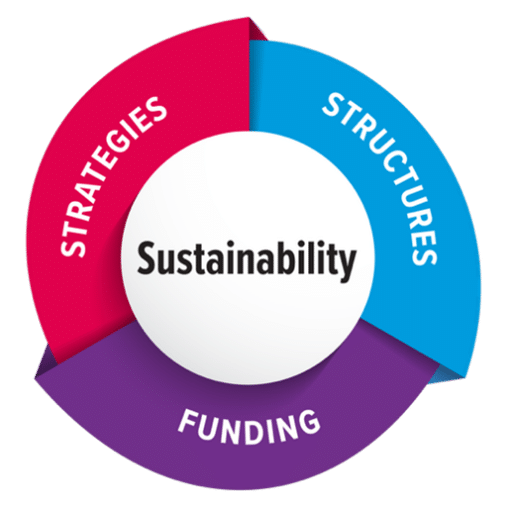
That’s why KnowledgeWorks has developed a strategic sustainability approach grounded in best practices for long-term planning. This field-tested process helps leaders ensure that change efforts take root and endure. At the heart of this approach are three interconnected dimensions: strategies, structures and funding. Together, they help education systems move from isolated efforts to long-lasting transformation.
Three dimensions of sustainable education change
Strategies
Sustainability cannot be about maintaining the status quo – it’s about building the capacity to adapt, learn and improve over time. That’s where strategies come in. These are the ongoing actions, supports and systems that allow transformation to live beyond launch. Adaptive professional development, systems for scaling best practices and responsive feedback loops all ensure the work stays relevant and effective. Leaders must ask: Are we building supports that can grow with us? Are we equipping our educators with what they need not just for today, but for the future?
When strategies are designed with an understanding of policy such as curriculum requirements, educator licensure pathways or assessment models, they become more embedded and resilient. State policy can be leveraged for strategic innovation when it is responsive to local implementation needs and informed by practitioner expertise. But no strategy can thrive without the right structures in place.
Structures
These are the foundations of the system. Structures include the decision-making processes, roles and mechanisms that are put in place to manage and refine the work. Sustainable systems are built with clear leadership pathways, inclusive governance and a culture of continuous improvement. When the operational structures are strong and well-defined, teams can move forward with purpose and can adapt when faced with certain shifts in leadership, climate and culture.
Structural clarity is also essential for successful policy implementation. Policies that lack local ownership or action plans often stall. When policy is supported by intentional structures including cross-functional leadership teams, feedback systems and shared accountability, its impact is broader and more sustainable.
Funding
As with all things, funding is critical. But sustainability demands more than an evaluation of a bottom-line number, it calls for a strategic approach to resourcing. Diverse funding streams, cross-sector partnerships and investments in time and space for learning are essential. What non-financial assets can your community bring? How might public dollars be braided with philanthropic or private support? Financial sustainability isn’t just about having enough money; it’s about aligning resources with vision and creating room to grow.
At the same time, funding policies such as weighted student funding formulas or grant eligibility rules can serve as enablers of transformation when deliberately linked to sustainability planning. Systems that plan how to sustain innovations beyond initial grant dollars, and that understand how to tap into existing policy-based funding channels, are more likely to scale changes that last.
From traditional to transformational change
Traditional
- Driven by what’s always been
- Top-down
- Compliance
- Reactive
- Siloed
Transformational
- Driven by a vision for the future
- Distributed
- Support to ensure equity
- Adaptive
- Aligned
Taken together, these three dimensions allow systems to move from traditional education models that are compliance-driven and siloed to truly transformational ones. Transformational systems are guided by a shared vision and unified purpose. And they are powered by adaptive leaders who look to leverage existing tools like policy, funding mechanisms and convening power to activate the changes they seek.
When done with intent, planning for sustainability and developing strategies for policy implementation can turn short-lived initiatives into systemwide change. By aligning initiatives with policies from the outset – whether at the district, state or federal level – leaders can build coherence. Policy is no longer viewed as a constraint, but as a catalyst for scalable transformation.
Shared responsibility, collaborative leadership
Every stakeholder, including educators, administrators, families and community leaders must play a role. But roles must be clear. Just like building a home, lasting change requires everyone to work together from the same blueprint, with each party contributing their expertise. When this alignment happens, levers of change become easier to pull. Leadership becomes more distributed. Commitment becomes more organic.
These five questions can help gauge whether transformational shifts are happening and if they are being built to last:
- Perceptions – Do people see the value of this work?
- Priorities – Is this truly a leadership and community priority?
- Support – Are we investing in the tools and learning needed to implement well?
- Teacher Efficacy – Do educators feel confident and equipped?
- Results – Are we tracking and sharing evidence of impact?
What lever can you activate in your role? What step forward can you take today to lead toward transformation?
Whether that’s building a new partnership, making a policy shift or simply listening to those affected by the work, transformation is not a solo act; it’s a shared responsibility.
With thoughtful planning, collaborative effort and a long-term view of our desired future, we can build transformational education systems that endure.