Home›Work With Us›Education Transformation and Student‑Centered Systems Change
Education Transformation and Student‑Centered Systems Change
Education Transformation and Student‑Centered Systems Change
Across the country, education leaders are working to shift systems toward learning experiences that are more personalized, competency‑based and responsive to students’ needs. While many systems share a vision for learner‑centered education, making that vision real remains a challenge. Fragmented initiatives, short‑term pilots, policy constraints and political polarization often limit the durability and reach of change.
National transformation requires something different: sustained, systems‑level work that aligns vision, builds capacity and creates the conditions for change to take hold over time. KnowledgeWorks’ national transformation strategy is designed to support education systems in doing exactly that.
Why systems struggle to move from vision to reality
Most education systems are not short on ideas. Many have articulated Portraits of a Graduate or learner‑centered goals that emphasize agency, relevance and equity. What systems often lack are the structures and supports needed to translate that vision into everyday practice, across schools and over time.
Sustainable change depends on three things moving together:
A shared vision that guides decisions and aligns stakeholders
When any one of these elements is missing, transformation stalls. Systems may see pockets of innovation, but those efforts rarely spread or last.
A strategy built around what systems need to succeed
KnowledgeWorks’ national transformation strategy focuses on partnering deeply with states, districts and schools to help these elements develop together. Rather than offering disconnected programs or one‑off technical assistance, the strategy centers on long‑term, place‑based partnerships where systems can build coherence and momentum.
Within partner communities, the work is intentionally aligned around three interconnected areas that education systems consistently identify as critical to change.
Vision: Systems are supported in developing and strengthening learner‑centered visions that are shared across state, district and school levels. Often articulated through a Portrait of a Graduate or Learner, this vision provides a common north star for decision‑making, resource allocation and instructional design.
Capacity: Vision only matters if people can act on it. The strategy prioritizes building educator and leader capacity through district and school design teams, coaching, professional learning structures, continuous improvement processes and access to a national network for educators. The goal is not compliance, but confidence and competence: the ability to design, implement and refine student‑centered and competency‑based practices over time.
Supportive environment: System leaders regularly point to policy barriers that slow or stop innovation. KnowledgeWorks’ strategy addresses this by working alongside leaders to interpret existing policy, identify opportunities for flexibility and build more enabling conditions where needed. This includes developing practical tools that help leaders navigate policy and align it with learner‑centered goals.
These elements are mutually reinforcing. A strong vision drives coherent action. Capacity allows educators and leaders to turn that vision into practice. Supportive environments remove barriers and help new practices take root.
Leadership development for lasting change
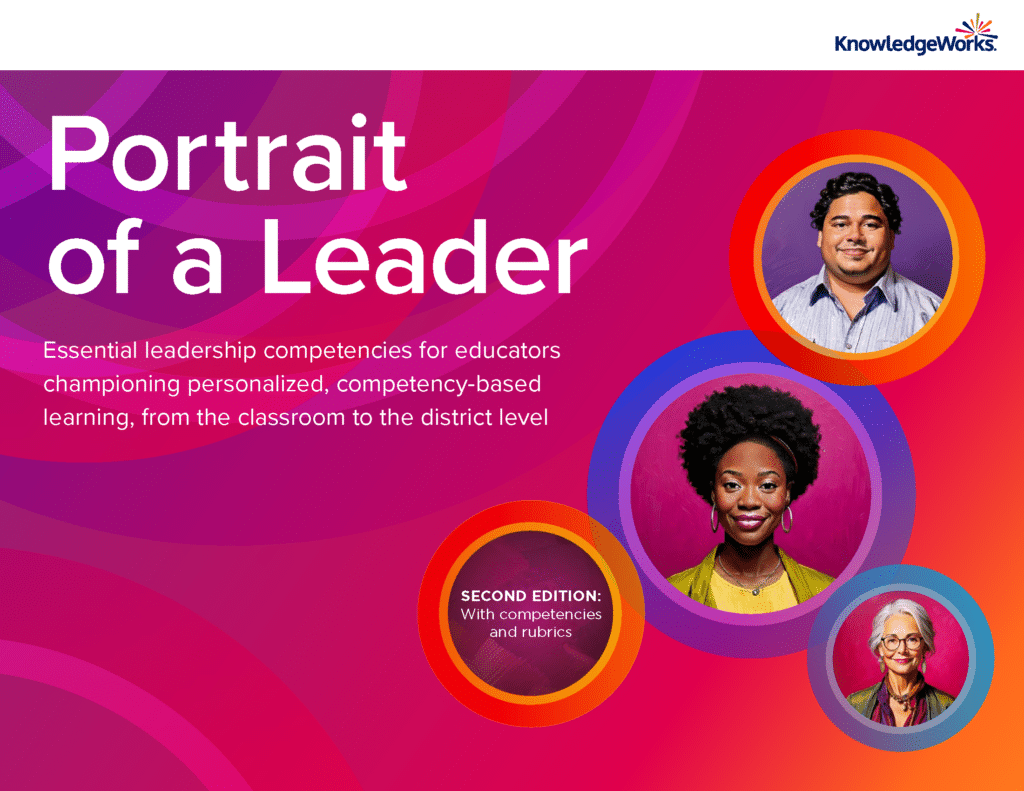
The Portrait of a Leader defines the knowledge, skills and mindsets essential for leading systems change in schools and districts advancing personalized, competency-based learning. Grounded in the lived experiences of teachers, principals, district administrators and other instructional leaders, the Portrait articulates a shared vision for leadership development among those driving transformation in classrooms and school systems.
From local systems to national change
Transforming education at a national level does not happen through isolated reforms or one‑size‑fits‑all solutions. It happens when systems show what is possible, when educators and leaders have viable pathways forward and when policymakers can see clear, credible alternatives to the status quo.
By working deeply with states, districts and schools, KnowledgeWorks’ strategy supports education systems in doing the hard work of aligning vision, building capacity and navigating policy in ways that lead to durable, student‑centered change. That work is not an end in itself. It is how the field learns what it takes to shift systems at scale.
As education systems enact change over time, their experiences generate evidence that informs national conversations about policy, accountability and learning design. Lessons from implementation shape research, tools and networks that support leaders beyond any single geography. What begins as local systems change becomes shared national knowledge.
This approach recognizes that national transformation is both practical and cumulative. It is built from the ground up through sustained partnerships with systems that are willing to lead. Over time, those efforts influence how success is defined, how policy is written and how leaders across the country imagine what learning systems can become.
The goal is not strict replication but building systemic momentum. By grounding national transformation in what works for real students and educators, the strategy helps ensure that student‑centered learning is not a niche initiative, but a viable and scalable direction for education systems nationwide.