We live among systems. We always have and always will. When we reflect on the past or anticipate the future, we need to notice the systems at work and analyze their dynamics. Doing so will help us understand how to anticipate, prepare for, react to and reflect on disruptions that threaten learning and stability for young people and communities.
KnowledgeWorks’ newest publication, Navigating Disruption in Education, offers us the chance to look at possible disruptions with a systems mindset.
“Disruption” refers to a change that interrupts the daily life, operations or plans of an institution or learning community and requires some kind of response. A disruption might be an event, large or small. It might reflect a tipping point in a change that has been building over time. A disruption might interrupt regular activity for days, weeks or even years. It might also change the operating environment forever. (Source: Navigating Disruption in Education)
A systems iceberg
Taking a systems mindset means looking at what is happening beneath the surface. Events or patterns are rarely random. They are the byproducts of underlying structures and beliefs. The systems iceberg is a common tool to help illustrate these layers.

As an example, think about how students collaborate in a classroom. Perhaps a group of students is struggling to work together. First, we can aim to understand whether that event is part of a pattern. How have the students interacted in the past? Does the current struggle reflect the way these or other students collaborate more generally?
If an event is part of a larger pattern, we can look one layer deeper at what might be contributing to the pattern. Continuing the example, what classroom structures have been put in place to support collaboration? What barriers to collaboration might exist, either because of the physical environment or classroom expectations? Perhaps the room is organized in a way that makes conversation difficult or the students are expected to be silent most of the time. These are all subtle components of the system that would have a real impact on how the classroom operates.
Next, we can look at beliefs, which drive systemic structures. What do the teacher and the students believe to be true about collaboration? Do they value it? Are they afraid of it? Do they believe that they can do it? Uncovering the lowest layer of the iceberg can illuminate why the structures that exist are there, why the patterns continue to repeat and why the events we observe are happening.
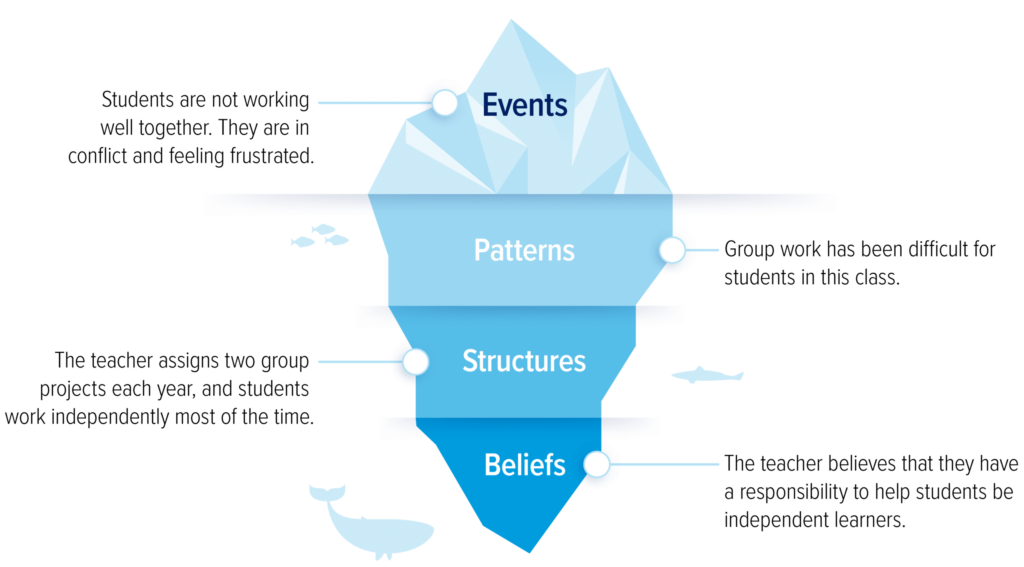
Going through this exercise can help us understand what is happening that we may not be able to see but that is nonetheless creating the conditions for what we can see. Once we can name what is happening at each layer of a system, we can clarify what we hope to change and find opportunities to shift the system at deeper levels instead of just addressing surface symptoms.
The systems iceberg and navigating disruption
Navigating Disruption in Education explores how leaders have managed disruption in the past and offers a new framework for navigating the emerging reality of accelerating, compounding and cascading disruptions. When reading the publication, we can apply the systems iceberg to think through how those past and present realities may have come about and how to shift toward a new way of approaching disruption.
A disruption toolbox for education leaders
This section begins with a description of how disruption in education is typically managed today.
Today, education leaders’ attention and energy and education systems’ resources related to disruption focus on reacting and recovering after an event occurs. In today’s environment, this “take-it-as-it-comes” approach leaves people exhausted and dealing with the social, financial, emotional and educational consequences of instability. It also hampers any hope of creating the intentional change that so many leaders work tirelessly to create and that education systems so desperately need.
As you read this section, ask yourself the questions below.
- What events and patterns does this section describe?
- What structures were in place that allowed those events and patterns to occur?
- What beliefs allowed those structures to be put in place? What ways of seeing the world made those structures seem reasonable?
- Where do you see those events and patterns, structures, and beliefs in your life and work today?
Welcome to Anytown, U.S.
The publication includes three scenarios that describe three possible futures for a fictional community in ten years’ time. Each scenario is a story about disruptions that have occurred in Anytown and how leaders and communities dealt with them. As you read this section, ask yourself the questions below.
- What events and patterns does each scenario describe?
- What structures might be in place to allow the events and patterns to occur?
- What beliefs might allow those structures to be put in place? What ways of seeing the world might make those structures seem reasonable?
- Where do you see any of these possible future events and patterns, structures, and beliefs already at work today? Which ones might you want to enable, and which ones might you want to shift?
Looking beneath the surface to create change
Our education systems do not operate the way they do by accident. They are the result of beliefs, structures and patterns that have led to the events we see. In the same way, education systems will not weather disruptive change by accident. By applying the tools of futures and systems thinking, we can explore what we hope to see and what must exist beneath the surface to make it so.