Artificial intelligence (AI) capacity continues to grow exponentially. In just a few short years, we’ve moved from chatbots that could maybe generate a handful of coherent and meaningful sentences to models with powers that seem boundless, sometimes to a frightening degree.
As AI model capacity improves and companies integrate AI tools deeper into their structures, the skills needed to succeed in a rapidly changing world are undergoing a corresponding shift. To better prepare students for this future, schools must reimagine the way they operate and the knowledge they emphasize to ensure students leave K-12 education with the skills necessary for future success.
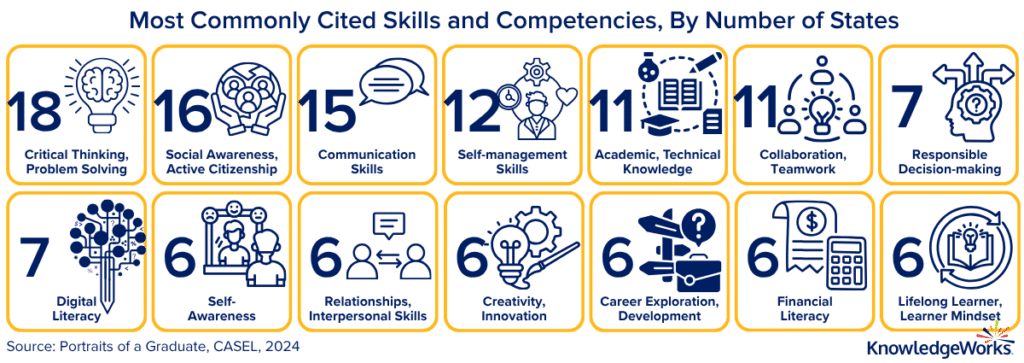
Portraits of a graduate represent an underpinning vision document used by many schools and districts to articulate these skills. At least 23 states and D.C. have adopted a version of a statewide portrait into their visioning documents. These documents, while not all alike, have many commonalities in what they emphasize, such as critical thinking and analysis, communication, creativity, collaboration and social intelligence, self-awareness and some version of digital literacy. These also happen to be many of the same skills that show up as crucial to becoming an AI-ready graduate, albeit in slightly different forms. For example, the International Society for Technology in Education (ISTE) has a portrait of an AI-ready graduate, which names as its skills learner, researcher, problem solver, connector, storyteller and synthesizer.
But it isn’t enough to establish a portrait. Without structures that reinforce it within classrooms and schools, it risks becoming little more than a poster on the wall. Incorporating the portrait into graduation requirements and aligned systems represents one strategy that states can use to emphasize the importance of the portrait and AI-ready skills. It can incentivize or require real adoption at the school and district level.
What do we mean when we say AI-ready skills?
AI-ready skills are the knowledge and habits students need to work effectively with AI tools while applying human judgment, ethics and verification. We must foster these skills in learners.
States’ strategies for supporting AI readiness in visioning
While a number of states have portraits established, only a handful of them have portrait-aligned graduation requirements established, collectively several valuable strategies have begun to emerge that could be replicated by other states.
Aligned portrait resources
States might consider developing additional resources aligned specifically to their existing portraits that make the direct connection between portraits and AI-ready skills. Utah has developed a portrait of an AI-infused learner, which builds on their existing portrait of a graduate.
Diploma endorsements
Some states have established diploma endorsements aligned to portrait requirements that provide evidence of when students have achieved the skills articulated in a portrait.
Indiana recently revamped their graduation requirements to create several seals that students can earn on top of a standard diploma. At the highest level, the Honors Plus Seals all require a demonstration of several of the state’s portrait-aligned qualities, specifically communication, collaboration and work ethic for either the enrollment or employment pathway.
Ohio has several different seals that students can earn on top of their graduation diplomas. One of these is the Ohio Means Jobs Readiness Seal. The seal requires students to demonstrate proficiency in 14 identified professional skills, which include a range of qualities typically included in a statewide portrait.
Portrait-aligned graduation requirements
At least two states have or will require students to demonstrate mastery of the skills articulated in their statewide portraits as a condition for graduation.
Virginia’s current graduation requirements state that students must “acquire and demonstrate foundational skills” in Virginia’s five portrait-aligned attributes to receive their diploma.
New York will be phasing out their longstanding Regents exams in favor of a graduation requirement that students show mastery of the six qualities embodied in the state portrait of a graduate. This requirement will become active for students who enter 9th grade in fall 2027.
Portrait-aligned processes for meeting graduation requirements
At least one state has gone so far as to propose a process for awarding graduation requirements built entirely around its portrait and related set of competencies. North Dakota has established what they call their “mastery framework” policy. This policy allows school districts to develop a locally created mastery framework, which is functionally a plan to allow districts to award students credit toward graduation when they master elements of the North Dakota learning continuum. This is based around a set of cross-cutting competencies organized into content areas.
Alternative transcripts
While transcripts are not in and of themselves graduation requirements, incorporating portrait-aligned skills into transcripts can be a way to emphasize their importance in the process of graduating. At least one state, Washington, has taken steps to create a formal statewide mastery transcript. In 2024, the legislature required the state board to craft recommendations for a transcript based on mastery. The state board’s initial recommendations are that the transcript should include a measure of competencies earner or in progress, including linked evidence samples.
Graduation plan requirements
Many states have requirements for students to establish some variation of a postsecondary success plan, requiring students to stay on track to graduate while preparing them for future success. At least one state, New Mexico, has established a requirement that these plans align with locally created graduate profiles, which all districts in the state are legally required to create.
Accountability systems
Federal law requires all states to establish statewide accountability systems for K-12 education. While these systems have traditionally focused on more academically oriented measures, in recent years, states have begun dabbling with ways to include high school skills acquisition into these systems.
North Dakota has included these skills formally in its federally required system through its “choice ready” measure, which includes demonstrating competency in 21st-Century skills.
Indiana recently included a measure of portrait-aligned skills, specifically communication and collaboration, into their state accountability system. Measurement of this is currently being piloted in schools.
Kentucky recently passed legislation creating a statewide framework for local accountability systems, which includes a measure of “vibrant learning, that often captures mastery of local profiles. Many districts across the state have already created such local accountability systems, which frequently include measures of vibrant learning and completion of local graduation requirements built around portraits.
And North Carolina is another state that has considered adding portrait-aligned traits to its accountability model.
Integrating AI-readiness policy now for the future
None of these approaches to integrating portraits and the aligned AI-ready skills into graduation requirements is necessarily better than others. States may find some or all of these possible and may need to strategically choose which opportunity to pursue. Others may find one or two that work in their political and policy context. But if systems don’t change, requirements may reward outputs that are easy for AI to produce, rather than thinking, evidence and judgment. And collectively they reinforce the real ways in which states can leverage graduation requirements to make their portrait meaningful and emphasize the responsible and transparency use of AI while still supporting student agency.