Across education and workforce systems, leaders are grappling with a shared reality: our systems are fragmenting. As long-standing structures are breaking apart, new ways of orginzing and supporting learning are emerging – and not at the same pace. In this environment, no single organization or sector can carry transformation alone.
One promising response is the increase in interest in and formation of networks and ecosystems. These structures can bring coherence to fragmented landscapes, accelerate innovation, reduce redundancies and help communities seed the learning systems they aspire to create. We’ll explore how Remake Learning, LearnerStudio and KnowledgeWorks’ Lead for Learners show the effect networks and ecosystems have on teaching and learning.
Why networks and ecosystems matter now
In recent KnowledgeWorks publications – Charting a New Course for Education, Nurturing What’s Next, and Laying the Foundation for Transformational Change in Education – networks and ecosystems repeatedly emerge as both a response to fragmentation and a strategy for change.
As systems fragment:
- Redundant efforts multiply
- Resources become scarcer
- Innovation becomes isolated rather than shared
Networks and ecosystems offer a potential solution. They connect people and organizations around shared aspirations and purpose, reduce duplication and create the conditions for quality learning to spread.
At a macro level, national initiatives such as LearnerStudio illustrate this role. Rather than operating as a single network, LearnerStudio acts as a convener of conveners. In a fragmented environment, networks can accelerate transformation by coordinating big lifts across large entities. They bring coherence and cut down on duplicative efforts.
Regional ecosystems: collaboration as a superpower
The power of networks becomes even more visible at the regional level. Consider long-standing regional learning ecosystems like Remake Learning in Southwest Pennsylvania. For nearly two decades, this ecosystem has connected educators, philanthropies, cultural institutions, higher education and community organizations around a shared commitment: making the region a great place to be a learner.
Participants consistently describe the region’s greatest strength not as a single program or initiative, but as collaboration itself. This collaboration shows up in many ways and are reflected in Remake Learning’s core ecosystem stewardship activities:
- Connecting and convening people across within and across sectors
- Catalyzing innovation through small-scale experimentation
- Communicating progress and celebrating change
- Appreciating learning culture
- Sustaining relationships over time
In Southwest Pennsylvania, people show up for each other. They work together across perspectives and areas of expertise. To a person, participants pointed to Remake Learning’s long‑term investment in relationship‑building as foundational to that culture. Importantly, this work has helped learning become more joyful, relevant and engaging – while reinforcing the idea that learning is a lifelong process.
Seeding the next learning system
In KnowledgeWorks’ forecast strategy guide, partners emphasized the need to sow the seeds of the system we aspire to create, rather than trying to retrofit existing structures.
Networks and ecosystems are central to this work. Their core practices – connecting, convening, catalyzing and sharing – mirror the behaviors needed to grow new systems.
Dense networks of relationships make it possible to:
- Hold multiple perspectives despite increasing fragmentation of education systems
- Develop shared visions across differences
- Build something collectively owned
- Adapt as needs evolve
In this way, ecosystems are not static solutions. They are living, adaptive structures that shift over time as conditions and priorities change.
If we think about LearnerStudio as a convener of conveners, that’s exactly what it’s doing – creating the conditions to seed a new system. And if we bring it home to KnowledgeWorks, our Lead for Learners national network does this work as well, with a clear mission: scaling the practices of personalized learning through leadership.
Lead for Learners: a national network with a clear purpose
At KnowledgeWorks, Lead for Learners exemplifies how a network can support systems transformation with focus and intention.
Lead for Learners is a national network designed to:
- Build leadership capacity
- Share expertise across communities
- Scale personalized learning practices through leadership
The work is intentionally scoped, led by educators in the field and not KnowledgeWorks. Rather than attempting to do everything, the network focuses on building a strong bench of building-level and systems-level leaders who can advance personalization in their own contexts.
A benefit of networks like Lead for Learners is community. Change work – especially on the leading edge – can be isolating. Knowing that others are engaged in similar work creates psychological safety, reinforces shared purpose and reminds participants they are not alone.
What makes networks and ecosystems successful?
Successful networks and ecosystems share several common conditions:
- Clear Purpose: It starts with vision. Begin with the end in mind. Know your problem of practice or outcome you’re seeking. Networks need a clear-eyed sense of why they exist right now. For Lead for Learners, that purpose is leadership development for personalized learning. For other networks, the focus may differ, but clarity helps people decide how and when to engage.
- Mutual Value: Assess whether a network can help move you toward your shared vision. Participants must see relevance and be able to both contribute to and benefit from the network. When a network responds to real needs, people are more likely to give back in meaningful ways. Enter with openness to both expected and unexpected benefits.
- Flexibility Over Permanence: Ecosystems are always in flux. They do not need to look the same five or 10 years from now to be successful. The principles might remain, but the form might change. In some cases, it is appropriate for networks to scale, shift or even sunset once their work is done. Participation in networks does not need to be constant to be valuable. People may engage deeply for a period of time, step back and re-engage later when relevance returns. If a network no longer feels relevant, stepping away can be a healthy and appropriate choice. Letting go of the assumption that everything must last forever is a critical mindset shift for education systems.
Networks disconnected: a community scenario
Imagine a mid-sized metropolitan community with multiple existing networks that aren’t tapped into each other. They might be:
- PK–12 school systems and their supporting intermediaries
- A business and workforce coalition, such as a chamber of commerce, young professionals group or a startup incubator
- A network of cultural institutions, such as zoos, botanical gardens, libraries, museums and art centers
- A coalition of regional historical sites, museums and organizations
- A coalition of cultural organizations, such as shared identity groups or community centers
- Higher education partnerships
Each network operates independently, yet all share a stake in the success of young people as education constituents.
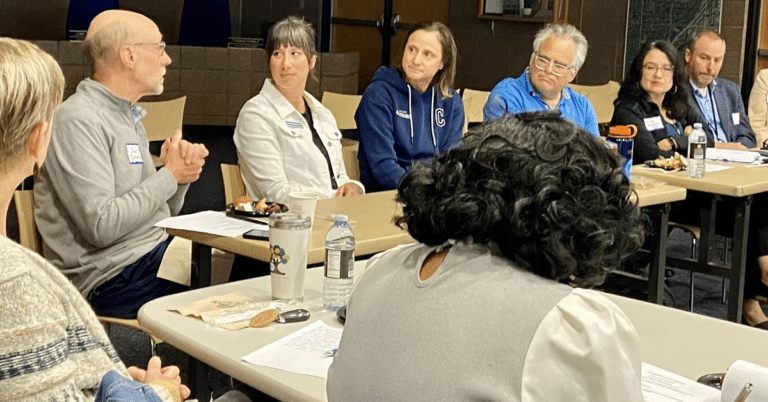
Rather than creating an entirely new structure, ecosystem-building might begin with something simple: a conversation, a shared meeting or an informal gathering. Over time, these interactions could evolve into coordinated efforts that leverage each sector’s unique strengths – career exposure from business partners, experiential learning from museums and instructional expertise from educators. They might invite input and interest from funders. Big systems change often begins with small, human moments that are nurtured over time.
What could a network or ecosystem around learning look like in your community?
Moving forward together
In a fragmented environment marked by scarcity and competition, networks and ecosystems offer a different path – one grounded in shared purpose, collaboration and adaptability. When we create the conditions for people and organizations to connect meaningfully, we do more than coordinate efforts. We build trust, expand possibilities and begin shaping learning systems that are more humane, equitable and responsive to the world learners are actually experiencing.