Exploring future possibilities can feel abstract. Distant. It can be hard to imagine our own lives in 10 years, much less something as complex as what a district might look like or how the broader education landscape might change. Trying to cast our minds so far forward can feel overwhelming.
What is an immersive futures experience?
Enter immersive futures that bring specific possibilities to life. Experiential futures, like those in our immersive experiences, are productions of some scale that invite people to participate in exploring future possibilities as active audience members. The curators of an immersive futures experience set the stage through something like a future graduation party, newscast or open house. They might use technology to illustrate a possibility or invite interaction, or they might craft an entirely analog scene using props, physical materials and actors.
Then participants enter the scene and carry out some kind of activity. Their contributions shape the narrative arc of the experience.
How do immersive futures help us explore the future of learning?
Immersive futures can help people “experience” the future through different kinds of interactions and situations. For example, talking with recent graduates and educators from a future school, listening to news to inform ideation or speaking with educators from 2035 about the new roles they play and skills they use. Participants spend time in a fictional future, observing what it looks and feels like and noticing what questions, excitements and objections arise. Then they come back to the present and reflect in some way. Maybe writing notes from the future to their present-day school or selves, considering how what they’ve witnessed might stretch their visions or surfacing opportunities and challenges that the future possibilities provoked.
Entering a future possibility in such ways makes the abstract future more concrete. More visceral. More fun. It helps ground exploration that could otherwise spiral into an overwhelming blur. In provoking thoughts and feelings and incorporating play, an immersive experience pushes participants to engage not just through their brains but also through their bodies. To put their whole selves in and see what that engagement shakes up. What they might want to bring back to the present. What they might wish to avoid.
How can immersive futures bring future possibilities to life?
At SXSW EDU 2026, KnowledgeWorks futurists Maria Crabtree and Jason Swanson produced a learning market day from the year 2036. Drawing upon the “Many Providers, Fluid Options” provocation from KnowledgeWorks’ forecast, Charting a New Course for Education, it invited conference attendees to step over a threshold into a future in which families and caregivers had $20,000 in public funds to allocate to whatever learning experiences most suited each child. Experiences were offered by a range of entities, including schools or school districts, arts organizations, city offices, libraries, community organizations or religious institutions.
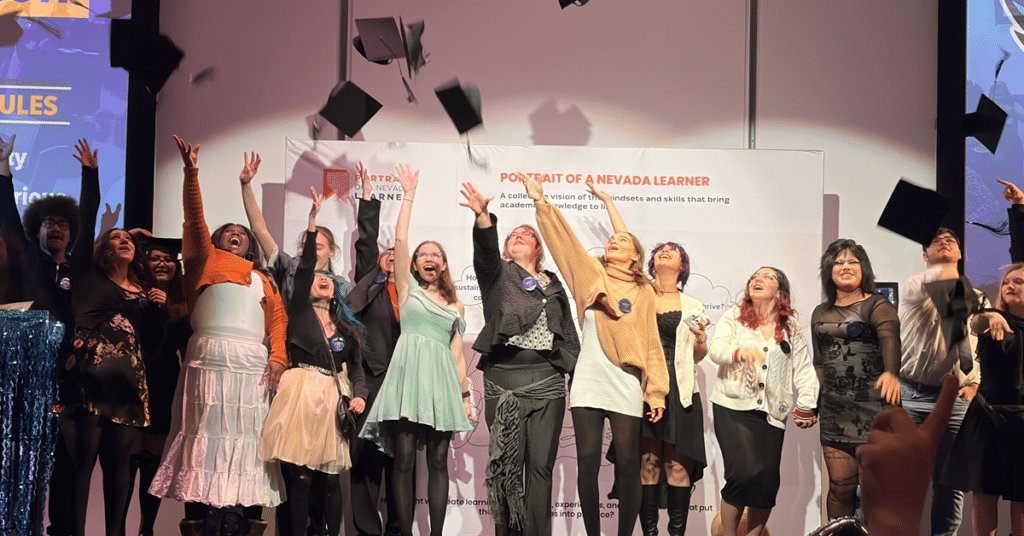
Participants adopted a persona and scoured a course catalog to identify offerings that would meet that character’s needs and reflect their interests. Then participants registered their personas for those courses. Along the way, they encountered artifacts from the future that illustrated the kinds of services and supports that might exist in an expanded, publicly funded education marketplace. Employees of a fictional learning space helped people go through the process.
On the surface, it resembled voting. Digging deeper, it felt like careful planning as participants grappled with schedules, budgets and transportation.
What kinds of insights can immersive experiences provoke?
When debriefing the experience, conference attendees wondered about extracurriculars, supports for students with IEPs and transportation. Some worried that inequity might increase. That this approach to education could be costly and time-consuming. That students might not know what they wanted to do or might not fully comprehend the available choices. That it could be harder to plan for staffing since enrollment could be less predictable.
Conversely, conference attendees saw opportunity in this scenario’s customization of learning for each student. In its focus on differentiation, choice and interest-based learning. In the broad range of providers not limited to the learner’s home community. Some thought that equity might increase through the availability of better opportunities for youth who might not otherwise have the types of experiences on offer. That such an approach could help adults support young people in their pathways, making it easier to collaborate with them on course selection.
What do immersive experiences do for participants?
By surfacing such implications, the learning market day immersion made a future possibility that can seem confounding feel real enough to process. It helped people weigh the allure of interest-based educational offerings against the responsibilities of having more choice. It surfaced student- and system-level considerations that would need attention if educational structures changed — or if constituents decided to change them.
Any given future possibility reflects a set of assumptions and suggests a range of implications. Possibilities that seem compelling could have unintended consequences, and those that seem challenging could have unexpected benefits. Spending some time observing a future possibility from the inside through an immersive experience can help people deepen their engagement with the scene. Exert agency by taking action within it. Feel the situation beyond their first reactions. Bring back insights to inform the decisions that they make near term.
7 Ways Immersive Experiences Help Us Explore the Future
- Make the future feel real: By blurring the line between imagination and reality, people engage with future possibilities in a tangible way and rehearse possible situations in a low-stakes environment
- Experience the future as shared experience: This type of shared experience can help people clarify and commit to a shared vision, create meaningful conversation and spark insights into new strategies and approaches
- Invite curiosity and improvisation: Participants can deviate from the script, explore ideas and respond to unexpected questions
- Get playful: Engaging in serious play can help lower resistance and resistance to thinking about the future
- Build confidence through preparation: A quick-start option for immersive events is giving people a simple character template beforehand
- Create ownership through design: Because they take place in a physical space, props and tools to help set the stage can strengthen the overall experience
- Spark imagination with future scenarios: By grounding experiences in plausible futures, participants can imagine and react to possible futures