In our latest forecast, we explored what might be possible if education systems moved away from centralized authority and toward governance models that genuinely distribute power across people, organizations and communities — radical power sharing. Power sharing isn’t just a structural change. It’s a deeper shift in how we think about decision‑making, agency and trust — and it shows up at every level of a learning system, from classrooms to regional ecosystems.
So how do you move from centralized authority to power sharing?
It starts with trust.
Trust is the non-negotiable.
Every example of effective power sharing rests on one essential ingredient: trust.
Trust doesn’t require deep personal relationships in every case, but it does require productive ones. We have to believe that others are acting in service of the shared vision and that they’ll follow through on their commitments. Trust enables disagreement without collapse and accountability without control.
Without trust, shared power falls apart. With it, collaboration becomes a source of strength rather than friction.
It requires a mindset shift.
At its core, power sharing begins with a belief: that we are better together. It requires questioning the assumption that power should rest with a single individual, role or institution. Instead, it asks us to consider what becomes possible when decision‑making is shared — when multiple perspectives, forms of expertise and lived experiences shape the path forward.
This isn’t simply a mindset shift for its own sake. It’s belief in action. If we say we value collaboration, learner agency and shared ownership, then our governance and decision‑making structures should reflect those values. Otherwise, we risk talking about transformation while reinforcing the same power dynamics we want to leave behind.
Making the shifts towards power-sharing structures doesn’t require sweeping change; you can start small. Look for access points when you’re asking: What are we already doing? And how can we think about the ways in which we can leverage more perspectives, more voice, more expertise into those decision-making processes, whether it’s governance or day-to-day operations.
Participate with purpose.
Power sharing doesn’t mean everyone decides everything all the time. Boundaries matter. There are moments when leadership requires making hard calls and moving forward. The goal isn’t paralysis. It’s participation with purpose.
We often see power sharing most clearly in personalized learning environments. When educators move away from being the sole deliverer of knowledge and toward facilitating learning, students gain voice, choice and agency. In these classrooms, power is already being redistributed — and learning thrives because of it.
When we look at community priorities and vision setting, schools can often shoulder the responsibility. But as schools look to make their walls more porous, they’re seeking to incent a lot of win-win partnerships across sectors. It’s a fantastic opportunity to think about power sharing and decision-making by inviting those groups to help navigate toward your desired future of learning. While this is practicing good partnership, it also opens up the doors to think about power sharing a little bit differently, too.
Across regions and networks, we see the potential of collaboration among schools, nonprofits, funders and community organizations. When these groups align around a shared vision, power sharing and decision-making becomes not just possible, but necessary. No single organization can — or should — carry systems transformation alone.
Anticipate variables and obstacles.
Let’s be honest: participatory governance is messy. Inviting more voices into decision‑making can slow things down, surface disagreement and create real tension. There are trade‑offs. Power sharing demands time, patience and a willingness to navigate ambiguity.
The critical question, then, isn’t whether power sharing is easy; it’s whether the outcomes are worth it. In many cases, they are.
Shared decision‑making can lead to stronger alignment, deeper commitment and more durable change. When people have a stake in the vision, they’re more likely to invest their time, energy and expertise to make it real.
Decision-making is ultimately a human-centered process. So when artificial intelligence (AI) enters the chat, it becomes tempting to de-center humanity. When we allow ourselves to let AI make decisions for us, we take away humanity — and ethics with it. No matter how small or innocuous a decision might be, it can snowball into larger decisions, if we let it. AI is programmed to agree with us and keep us using it, so in making a decision with the full scope of facts, opinions and experiences of a group practicing power sharing, we can have hard conversations with other humans. How might we develop educator roles such as a director of artificial intelligence in schools to ensure AI is harnessed properly?
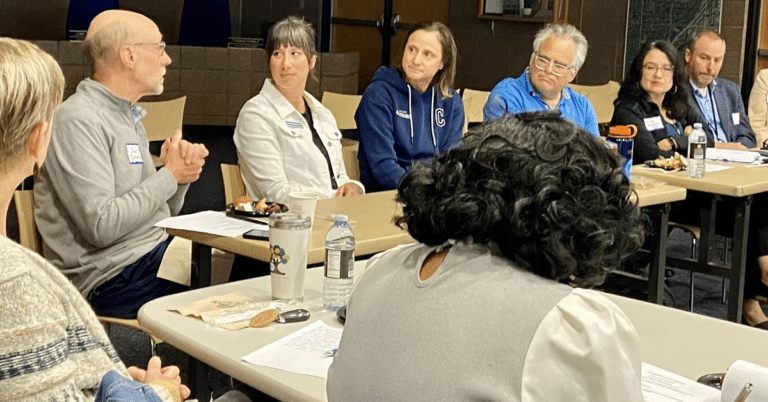
Hard conversations can also be a barrier to begin even thinking of power sharing, but they are necessary, especially when trust has been established. This part is where structures and parameters come in. When ideation or feedback phases are open to a wider group of people who may have widely varying thoughts, it helps to have facilitators or mediators to move along the process to continue driving the work. Ultimately, there may have to be a small group or one person who makes a decision doing forward, but it’s not without input and guidance from other education constituents, especially when a decision needs to be made because the cost of inaction is too high.
Practice the future now.
Consider the types of governance and decision-making processes that will get us to our shared vision and best mirror our own aspirations for the future of learning. In doing so, we have to ask ourselves what our friend Michelle King might ask: If that’s the future we want to live in, why aren’t we leaning into this now? Why are we doing the exact opposite in our day-to-day? By practicing what we aspire to, we can bring those pieces of the future to life more readily.