This article was cowritten with Ian McDougall.
Educators across the country are exploring how artificial intelligence (AI) can serve as a meaningful partner in teaching and learning.
While AI is a timely topic, its value in education emerges when educators focus first on what students should know and be able to do and use AI to support, not drive, the selection of activities, materials and instructional strategies. When used purposefully, AI can help educators streamline planning, deepen personalization and create more equitable learning experiences.
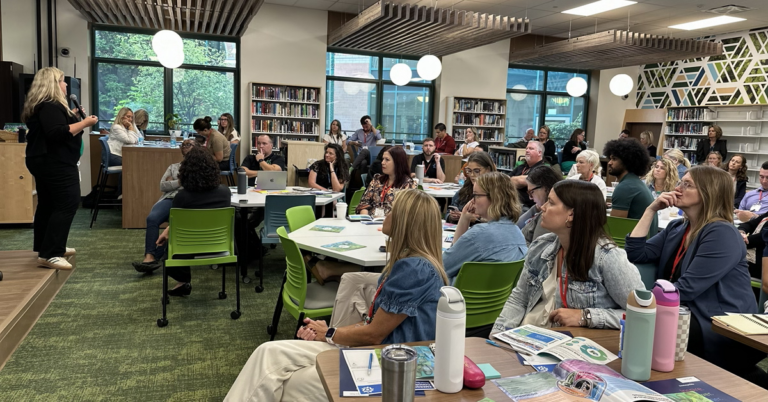
To better understand what this looks like in practice, KnowledgeWorks brought together personalized learning teachers representing a range of grade levels, subjects and specialties across the K–12 landscape. These educators contributed their expertise, tested ideas, challenged assumptions and helped co-develop a set of emerging themes for how AI can support personalized learning.
At the heart of this work was a simple question: In what ways can AI effectively support and enhance the practice of personalized learning for teachers?
Why use artificial intelligence for personalized learning?
In discussions with educators navigating AI in practice there was clear consensus on why AI holds promise for personalized learning.
- Effectiveness: increases personalization, unique learning opportunities and immediate feedback
- Efficiency: improves workflows and simplifies data collection and analysis
- Equity: supports differentiation, leads to more timely interventions and helps remove barriers to access
Importantly, educators emphasized that efficiency is not about cutting corners or saving time for the sake of convenience. It’s about reallocating time toward responsive instruction and meaningful collaboration with colleagues to support innovation.
Four essential personalized learning practices before using artificial intelligence
Before incorporating AI into co-designing curriculum, instruction or classroom routines, educators agreed that four core personalized learning practices should already be in place:
- Designing for variability: recognizing that students come with different experiences, strengths and needs and that personalized learning begins by honoring where each learner starts and designing appropriate learning pathways for success
- Establishing classrooms that support agency and independence: creating and modeling clear procedures and co-created expectations so that learners know how to navigate tasks and engage in independent problem-solving as active participants in their learning
- Cultivating student ownership: reflecting on practice and adjusting instruction to create space for students to make decisions about their learning; this requires flexibility and a willingness to release control in support of student ownership
- Designing with purpose: clarifying learning goals and criteria with learners, using those targets to guide instructional decisions and thoughtfully considering differentiation and agency when designing learning experiences
Four core personalized learning beliefs for an AI-enabled classroom
Conversations with educators surfaced a shared set of assumptions necessary for AI to meaningfully amplify personalized learning.
- Learning is human-centered, not tool-driven. AI should serve personalization while reinforcing, not replacing, strong instruction, human thinking and the relationships that make learning matter.
- Digital literacy is essential. Educators must be able to guide and refine AI use rather than outsourcing instructional decisions to technology.
- Process over product. Teachers believe all students can learn and grow over time and design learning experiences that prioritize growth, reflection and continuous improvement.
- Human judgment remains paramount. Educators must check outputs to ensure accuracy and preserve the integrity of instruction.
Starting an AI journey with these norms in mind ensures that the work starts from a place that is aligned to the purpose of personalized learning.
Emerging themes: how artificial intelligence can support personalized learning
As educators explored practical, meaningful ways AI can support personalized learning, six themes surfaced as a clear throughline across perspectives.
1. Assessment and feedback
AI can strengthen assessment and feedback by making results more immediate and actionable. Educators shared that AI has helped them to quickly identify what students understand and where they need additional support, while also creating meaningful checkpoints that inform their instructional decisions. Leveled skill assessments, especially for reading comprehension, where questions can be directly aligned to standards, can improve accuracy and consistency. When used with intentionality, AI shifts assessments and feedback from time-consuming tasks into dynamic tools that support learning and growth.
2. Data-informed decision making
AI can enhance educators’ ability to turn complex data into clear next steps for instructional design. Teachers spoke about using AI to analyze state assessment results, summarize large sets of student work and performance artifacts and revise lesson plans based on emerging trends. AI can provide educators with advanced analytics and reporting to support collaboration, data-informed decision making and progress monitoring. Because AI simplifies the data analysis process, educators can focus their time and energy on interpretation and action rather than data management.
3. Engagement and relevance
AI helps to bring learning to life by connecting instruction to students’ interests and experiences. Teachers described using AI to hyper-personalize content based on learner preferences. Gamifying lessons through simulations or role-playing opportunities and providing alternative formats for students who are less comfortable speaking aloud are a few of the examples provided. AI can support student choice, bring new concepts to life through real-world scenarios and deliver instant, adaptive feedback that can keep learners motivated. Together, these uses contribute to learning environments where students feel engaged and genuinely curious.
4. Student agency
AI is a powerful support for building student ownership of learning. Educators have used it to design standards-aligned choice boards and personalized learning pathways that connect directly to clear goals and success criteria. Whether through flexible structures, project options or other forms, AI makes it easier to offer learners choice for how they will demonstrate understanding. By helping visualize skill progressions and learning growth, AI can support transparency and put students in a position to monitor their own progress. With AI as a partner, teachers can create learning experiences where choice and ownership are the norm.
5. Planning and instructional design
AI can support instructional planning by enhancing creativity, like generating innovative and standards-aligned project ideas, while reducing the time spent on routine tasks. Teachers found it valuable for co-designing lessons, essential questions and success criteria, as well as streamlining formatting, grammar and revisions. AI can also help with pacing unit plans or condensing content when time is limited. It also supports technical needs such as coding for Canvas or Canva. Used this way, AI expands what’s possible in planning while keeping educators firmly in the driver’s seat.
6. Differentiation
Differentiation becomes more manageable and more natural with the support of AI. Teachers use it to generate questions that deepen critical thinking, level texts across Lexile ranges and increase rigor for advanced learners. AI also helps educators embed accommodations directly into curriculum for students with IEPs, 504 plans, BIPs and multilingual needs. By quickly providing multimodal and multilingual content, AI allows educators to design learning experiences that balance access and challenge, while assisting with progress monitoring and translation.
Looking ahead: what this work makes possible
The findings from KnowledgeWorks’ AI working group, reflects an area of growing agreement among educators across the field, that artificial intelligence is a tool to support teaching and learning, not a substitute for quality teachers. As with any powerful tool, there are pitfalls to navigate, including the risk of unintentional cognitive offloading and the presence of bias in AI systems. However, when grounded in learner-centered beliefs and applied with intention, AI can support educators in bringing the promise of personalized learning closer to reality.
One thing is clear: the future of AI in education is not about removing human judgment but continuing to explore and refine how we can thoughtfully use strategic automation to amplify teacher expertise and create learning experiences that adapt to the evolving needs and strengths of each child.
Contributors
Thanks to our contributors that helped create this resource.
Brittany Terry, 5th Grade Teacher, Clover School District, South Carolina
Dane Jacobson, High School Teacher, Yuma Union, Arizona
Ian McDougall, High School Teacher, Yuma Union, Arizona
Jess Hensley, 3rd Grade Teacher, Kalispell School District, Montana
Sarah Kelly, Middle School Instructional Coach, Lexington School District One, South Carolina
Wesley Skiles, High School Special Education Teacher, Purdue Polytechnic High School, South Bend, Indiana