The world that once supported stable and predictable education systems is shifting beneath our feet. As social, political, and environmental conditions become more uncertain and sometimes volatile, the assumptions that once sustained public education no longer provide the solid foundation they offered past generations.
KnowledgeWorks’ most recent forecast, Charting a New Course for Education, argues that this uncertainty is not only a barrier but also a call to action. It urges system leaders to reimagine education systems that center humanity, relevance and a deeper sense of community in ways that past structures did not fully foster.
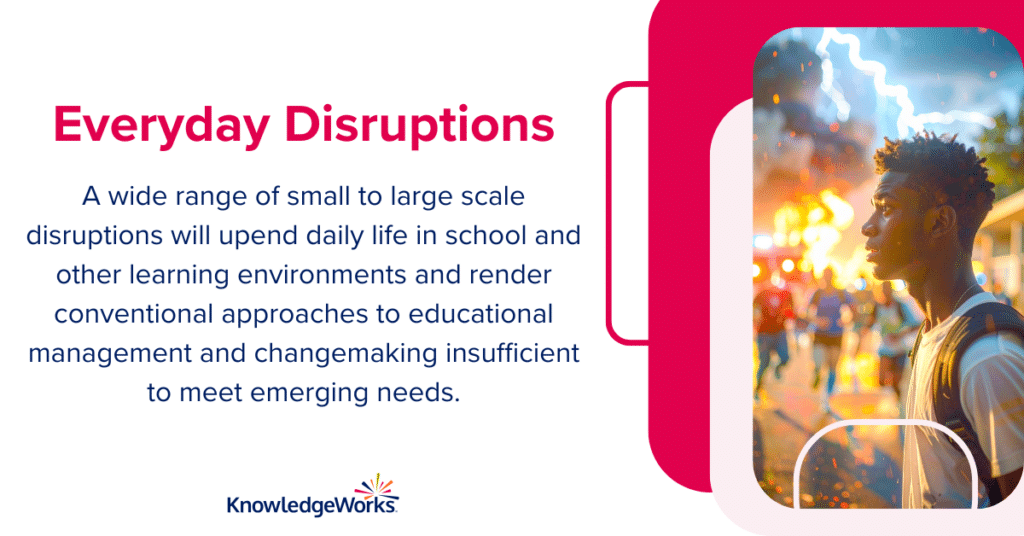
This sense of possibility becomes even more urgent when we consider the driver of change known as “everyday disruptions,” defined as, “a wide range of small to large scale disruptions will upend daily life in school and other learning environments and render conventional approaches to educational management and changemaking insufficient to meet emerging needs.”
School districts are now managing an increasing stream of destabilizing challenges that affect operations and have a dramatic impact on student learning. These include extreme weather, cyberattacks, displacement, health emergencies and conflict over what and how students learn. Disruptions may accumulate slowly or arrive suddenly, creating both immediate and compounding effects. Traditional management approaches are strained by this constant pressure, and the resulting instability widens inequities for students and increases burnout among educators. These disruptions also come at a time when learner engagement and attendance are declining while educator retention continues to lag nationally.
Because these disruptions are likely to intensify, education systems must become nimble and flexible to navigate ongoing disorientation. The coming decade requires adaptive strategy and operations, flexible leadership and new models that can respond to rapid and repeated change. Let’s took a look at what navigating disruptions can look like while highlighting examples from KnowledgeWorks’ work with states and learning communities that are already moving in this direction.
The need for education transformation
KnowledgeWorks uses strategic foresight and tools such as our forecast to help districts and states prepare for what lies ahead. We believe that shaping the future of learning requires translating insights about emerging trends into actions that begin today. A dynamic and responsive education system requires more than the spread of new practices across classrooms or districts. KnowledgeWorks believes that systemic change commences and is grounded in a shared vision that is supported by adaptable structures and by educators who have the capacity to deliver on that vision. This work draws from research on spread and scale in education as well as from strategic foresight. Each of these bodies of work should inform the other to create a connected, sustainable path forward.
Building on Cynthia Coburn’s reconceptualization of educational scale, KnowledgeWorks believes transformation depends on four interconnected tenets that move beyond surface-level implementation.
- First, systems must pursue depth. This involves genuine shifts in beliefs about learning and the potential of all learners, changes in school culture and the adoption of pedagogical practices that meaningfully alter how students experience learning. The goal is to increase engagement and foster agency so that students are well prepared for a dynamic world.
- Second, an ideal system is both nimble and designed for sustainability. Lasting change occurs when educators and leaders share deeply a vision that guides new approaches, and when districts become dynamic learning community continuing to improve and innovate.
- Third, spread is not simply the expansion of practices to more classrooms or schools but the movement and adoption of new ideas, norms and enabling practices to thrive throughout a district. Transformation becomes embedded in routines, professional learning structures and the flexible use of local policies.
- Finally, true transformation demands a shift in ownership. Authority and expertise must move from external catalysts to the educators and communities who will carry the work forward. When ownership shifts, schools build the capacity to adapt, reinterpret and strengthen ideas in response to emerging challenges.
Together, these tenets create the conditions for flexibility, agency, long-term commitment and coherence, all of which are essential for navigating current and future disruptions.
Transformation in action: San Luis High School, Yuma, Arizona
A compelling example of this work can be seen at San Luis High School in Yuma, located near the United States and Mexico border. The school serves more than 2,600 students in a community that is nearly entirely Hispanic and multilingual, with many English learners and migrant students. The context in Yuma, like that of many learning communities across the country, is both complex and rapidly changing. This includes fiscal strain coming from both the federal and state levels, political volatility present in the United States and the unique pressures on families and students along the United States/Mexican border. This makes the school’s learner-centered approach both necessary and instructive.
Yuma Union High School District and San Luis High School did not pursue quick wins. The district team sequenced its transformation efforts, starting with foundational work that strengthened student voice, standards-based grading and college-going supports. The school then added structures to build educator capacity and coherence, including professional learning tied to a clear instructional framework rooted in personalized, competency-based learning, coaching and observation cycles, monthly planning time, advisory supports and collaborative teams focused on evidence of learning and data-driven decision making. Each stage expanded teacher leadership and student agency. Over time, these ideas spread beyond isolated classrooms and became part of how the entire district plans, teaches and learns together.
These steps deepened practice by shifting classroom norms, built sustainability through ongoing professional learning, and leveraged policy flexibilities available to Arizona districts. District and school leaders increased shared, visible practices across departments and shifted ownership from a small group of innovators to the broader community of educators and students. The results appear not only in a steady upward trajectory in school performance but also in the daily experiences of learners who are developing durable skills, confidence and adaptability.
During a recent visit, I observed learners who could explain their goals, track their progress and demonstrate mastery in multiple ways. I also saw educators who were designing, testing and refining practices based on real-time needs. This is a learning community in full bloom, one that has built the capacity to thrive amid the everyday disruptions it faces and that has the shared ownership needed to continue facing future challenges with courage.
KnowledgeWorks’ forecast is clear. Disruption is not an exception. It is the operating environment of both the present and the future. If we want every learner to thrive, we must build systems that anticipate volatility while delivering coherence, care and preparation. Learners deserve academic knowledge, durable skills and the adaptability required to navigate an increasingly unpredictable world. The goal is simple and urgent. We must work together with schools, districts and states to build systems that meet today’s demands and prepare young people for a world that will continue to change.