Many entities, agencies and educators across Minnesota are taking part in a quiet but powerful movement to redesign the state’s education system to better meet the needs of every learner. That includes the Professional Educator Licensing and Standards Board (PELSB). As the stewards of educator quality and credentialing in the state, PELSB is stepping into the larger conversation of education systems transformation.
PELSB board member Amy Aho said that as the landscape of education continues to evolve, Minnesota’s Professional Educator Licensing and Standards Board is proactively exploring how to modernize licensure. “As we think about the future of educator licensure, one of the questions we need to be asking ourselves is how to best prepare educators with the skillset to meet the needs of our students in the future,” she said.
Exploring bold, long-term strategies for the educator pipeline
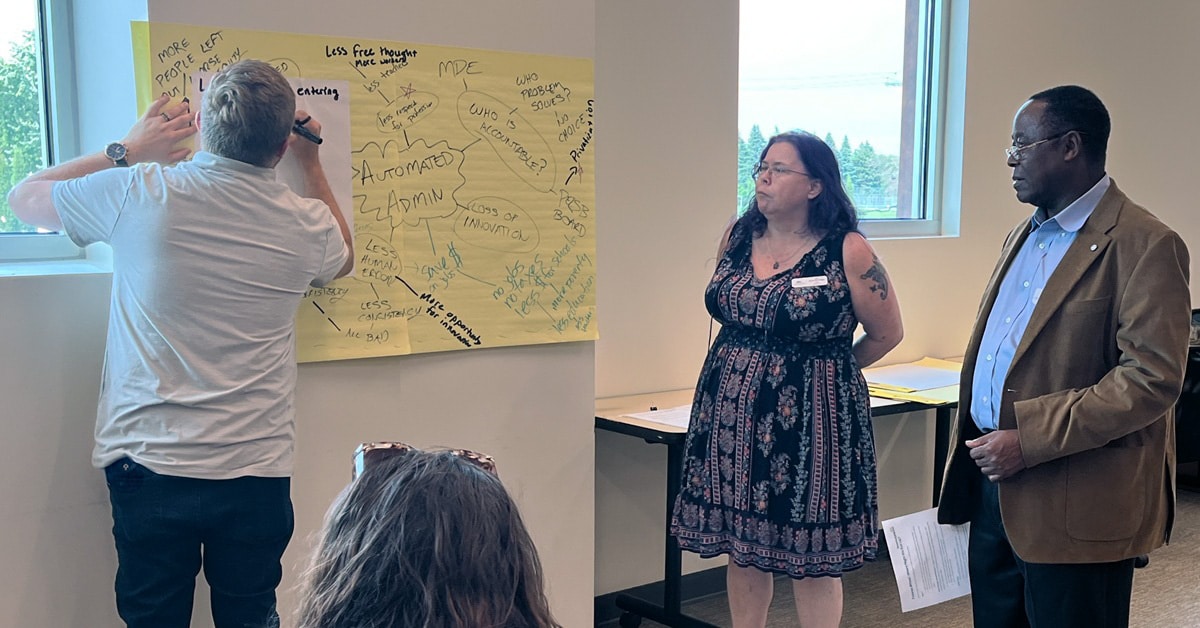
That guiding question shaped a recent workshop, where futures thinking was introduced as a strategic tool to help rethink educator licensure. Katie King, a futurist with KnowledgeWorks, led the session, facilitating a forward-focused dialogue among teachers, teacher preparation professionals and school administrators. The session aimed to move beyond short-term policy adjustments and explore bold, long-term strategies to strengthen and modernize the educator pipeline.
“Futures thinking isn’t about trying to predict the next big thing,” said King. “It’s about expanding the imagination and decision-making horizon. It helps us navigate uncertainty by surfacing the full range of what might be possible, and what outcomes are most desirable.”
KnowledgeWorks
Aho noted that the growing complexity of student needs and societal shifts have prompted state educators and leaders to partner more readily with the agency to begin rethinking teacher preparation, identifying outdated structures and exploring new paths forward.
“It can feel like a daunting task,” Aho added. “But I feel confident that Minnesota teacher prep programs, current educators and aspiring educators are committed to ensuring every student has the best opportunities available to them when they enter our buildings.”
Planning for a more satisfying, sustainable teaching profession
Discussions centered on how to make the teaching profession more satisfying and sustainable, especially considering ongoing teacher shortages and rapidly changing learning environments.
Participants explored several major forces that are already reshaping education, including:
- The potential for artificial intelligence in automating administrative tasks and supporting personalized learning
- Social fragmentation altering how communities connect with and support schools
- Climate change influencing student needs, local priorities and school-calendar planning
The group considered a wide range of scenarios such as fluid and flexible pathways into the profession, technology-enabled licensure systems and innovative staffing and learning models. The goal was not to settle on a single future but to build the capacity to plan across multiple possibilities and align licensure strategies with emerging needs and desires.
Shifts in policy to practice
Executive Director of the Board Yelena Bailey, Ph.D., noted that recurring tension emerged during the session: the need to balance essential standards with increased flexibility, particularly in smaller districts where current licensure structures may no longer be feasible or effective. “The Board is dedicated to rethinking licensure policy from the perspective of future student needs. This may mean moving towards more interdisciplinary licenses, replacing outdated fields, etc.,” she said. “The key to maintaining high quality while being responsive to local context is being open and excited about innovation, while simultaneously holding a high set of standards for teacher licensure.”
Participants discussed what shifts in policy and practice could support a more adaptive, student-centered system while maintaining rigor and equity.
The session represents one example of how states are using futures thinking to engage in systems-level planning and rethinking foundational structures, like educator licensure, to better align with its preferred future of learning. As education systems evolve, agencies like PELSB have a pivotal role to play in responding to current pressures but also working proactively to shape a more resilient and responsive profession for the decades ahead.